

“We learn to think of history as something that has already happened, to other people. Our own moment, filled as it is with minutiae destined to be forgotten, always looks smaller in comparison.”
— M. Gessen“When the future loses its promise, the past becomes a refuge.”
— Yi-Ling Liu, via workfutures.io
People: Quieter beta mums. Tarot booming in China. Economics of romance. Omiokuri.
Hemingway and loss.Society: The job ladder in structural decline — workers today half as likely to receive a better-paying outside offer as in the 1980s. Engels’ pause. Smartphones creating a myopia epidemic in children.
Paris “Tiers lieux”.Foresight: Extrapolated Futures Archive — a reverse-lookup for speculative fiction, organised by scenario type. Thin places — Celtic liminal spaces (in Irish, aiteanna fliuch, “wet places”).
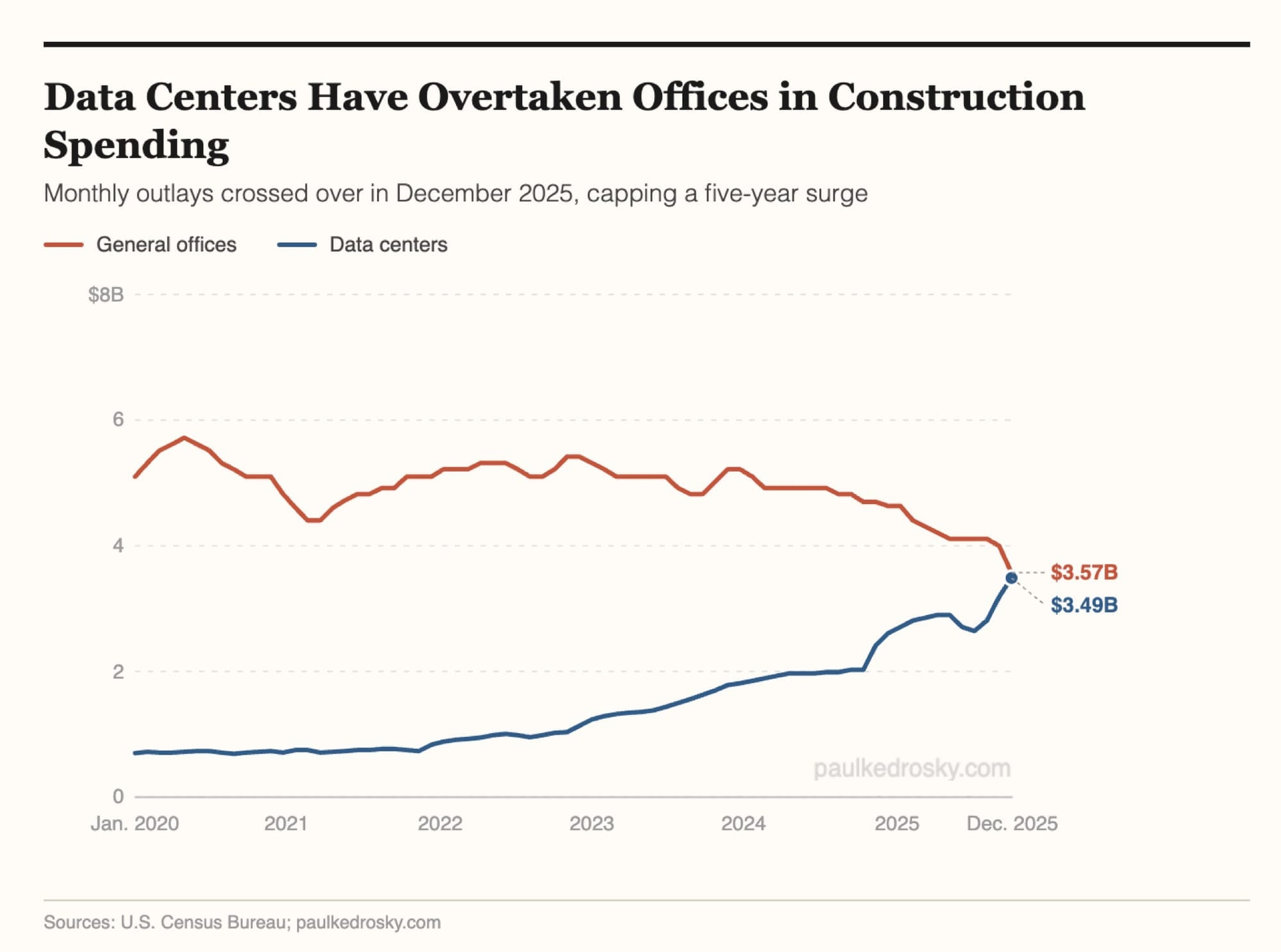
Tech: Your car is spying on you. Surveillance pricing is coming to grocery stores. Data centers overtook office construction in December 2025. Export controls are inadvertently capability-generating.
Producing all psychotropes in simple tobacco.
Random: Japanese snack packaging going grayscale — an ink shortage is stripping colour from the shelves. Martin Margiela, in a 1998 interview, on colour: “What is black? An absence, a presence, a mood, a coat. What is red? A blush, a redness, a fever, an order. What is skin? Protection.”
AI: Chinese labs: Claude is the preferred coding model across every lab visited. Vibe coding platforms (Loveable, Replit) leaking medical records, financial data, and Fortune 500 internal documents onto the open web.
Token inequality.
The Efficiency Moat
Bev had printed out seventeen pages of the report and highlighted them in four colours, which Marcus thought was itself an argument against the report’s thesis. The report argued, among other things, that the people who had learned to do the most with the least were now the most dangerous.1
“They’re getting four to seven times more intelligence per unit of compute,” she said, fanning the pages across the conference table. “Seven times. We’re just sitting here with all our chips, burning money.”
Marcus looked out the window. Their colleague Pat was walking to the parking lot below, and Marcus watched until Pat turned the corner and was fully gone from sight — which took longer than expected, because Pat walked slowly and the corner was further than it looked. Then Marcus turned back to the pages.
“Excel made more accountants,” he said finally.
Bev stopped. “What?”
“When Excel came out. 1993. Everyone thought it would replace accountants. It made more of them. Jevons paradox.”
“That’s not what I’m talking about.” Bev collected the pages and tapped them into a neat pile, a gesture she had learned from her mother, who had been the kind of parent who made her children’s homework schedules in advance and colour-coded them by subject. Bev had decided this approach had some merit, though she preferred to describe herself as “intentional” rather than “intense.”2
In the break room, someone had replaced all the snacks. The packaging was different — flatter, more subdued, everything in grey and black. The chips had always come in a shiny orange bag. Now they came in what appeared to be a photocopy of a shiny orange bag. “Ink shortage,” said the note on the fridge. “Normal service will resume when the supply chain does.”
The Cerebras chip had arrived that morning in a foam-lined case the size of a piece of luggage. It was a wafer — a literal silicon wafer, the size of a dinner plate — and it had cost more than Marcus’s car and possibly his flat. Bev had photographed it immediately and reverently, the way people photograph their children’s first steps. The chip was now in the server room downstairs, where it was, in theory, thinking.3
“The point,” Bev said, returning with a grey-packaged coffee, “is that efficiency is the new moat. If you learn to do more with less, the resources stop mattering.”
Marcus thought about this. He thought about Pat turning the corner, the way a person’s back tells you something their face doesn’t. He thought about how the tarot lady had told his sister that 2026 was the year of the Wheel of Fortune. Not the game show. The other kind.
“Maybe,” he said. “Or maybe constraint is just constraint. And we’ll know in ten years.”
Bev gathered her highlighted pages and left. Marcus watched her go until she turned the corner into the corridor and he could no longer see her, and only then did he get up to get his own grey-packaged coffee from the break room.
It tasted exactly the same.
1 The most efficient people: always the ones who were forced to be.
2 Colour-coded homework schedules remain, statistically, no guarantee of anything — though they do correlate strongly with the ownership of multiple highlighters.
3 Whether wafer-scale thinking is different in kind from smaller-scale thinking is a question the chip itself was not invited to answer.