

“Personally, I’m trying to code like a surgeon. A surgeon isn’t a manager, they do the actual work! But their skills and time are highly leveraged with a support team that handles prep, secondary tasks, admin. The surgeon focuses on the important stuff they are uniquely good at.” - Code like a surgeon.
People: Impact of people on crisis. Last moments brainwaves. GLP1 impact in obesity in the US. Bible sales and chipotle. Homo Idioticus. Zine culture is back. Job hugging.
Sperm racing.
Creator economy vs dignity.
Virtual zine library.Tech: Pitching the Dark start to investors. Coding like a surgeon. Charts of how the world is changing. Sonic fire fighting. The sort-a-brick robot. Anticancer soap.
Predicting thoughts. Taiwan’s (lack of) grid.Futures: Fungi as a futurist.
Security: China spies on US nonprofits. More drones in the US. Poland’s army training. Canada too. Shooting drones with lasers. Chernobyl shield damaged.
Life: Microbiomes in lungs. Efficient lifeform? Universal kidneys. Kissing. Mushrooms from reycled eggs cartons. Glowing sea. Origin of octopuses.
AI: The Office Manager 2.0. Fighting cybercrime. AI and learning. Pop-up stores. Lonely kids talk with AI.
Goldman' releases their Dev.AI out of the gym.
Infestation of human brains with slop.
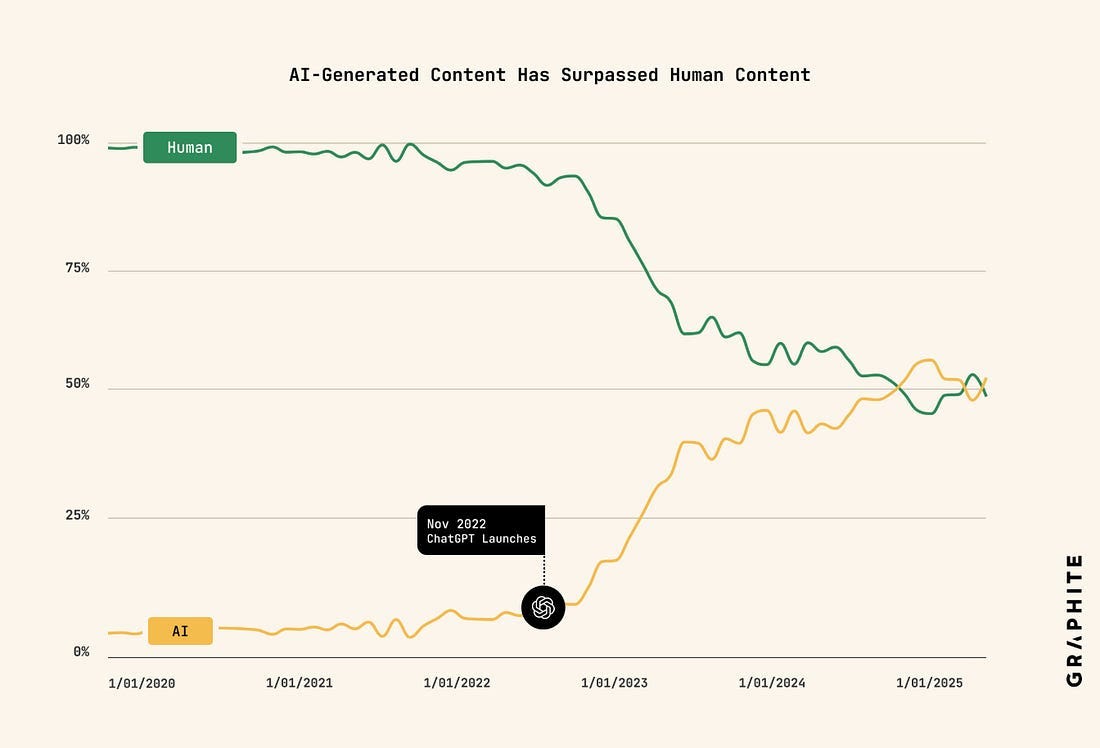
Whenever something is framed as new and exciting, be very wary about just uncritically adopting it or experimenting with it. Likewise, when something is being presented as “free,” even though billions of dollars of investment are going into it and it’s using lots of expensive resources in the form of public utilities like energy or water. […]

## Fragments of Reality: Navigating Humanity in the Age of AI
In the not-so-distant future of 2026, a young coder named Alex Lee found himself wrestling with a deluge of tasks. His AI assistant, Kai, had become an indispensable partner, deftly handling the mundane “Job” tasks like answering emails and organizing his chaotic digital files. Though Alex appreciated honesty from AI, the growing dependency left him feeling like a half-finished puzzle, a piece missing the essential ‘Gym’ tasks that honed his core coding skills. In a world filled with pop-up advertisements screaming, “Get Lifted by AI!” he yearned for more than automation; he craved engagement with reality, which, as it turns out, was fraught with challenges.
Troubles brewed on the geopolitical front, as a troubling drone strike had dented the New Safe Confinement structure at Chernobyl, once a shining symbol of engineering triumph. Reports of disarray inside the renamed “Toxic Park” became a source of bitter memes on social media—”If Chernobyl can’t hold it together, what hope for us?”—stirring existential debates rivaling those tackled by philosophers over the ages. Meanwhile, nations were ramping up their own military preparedness: Poland had embarked on its “Always Prepared” training initiative, aiming to equip 400,000 citizens with survival skills as a watchful eye remained on Russian advances. Alex couldn’t help but laugh at the absurdity of survival training expectations set against a global reality that felt more like a bad sci-fi script than life itself.
In a parallel universe—namely, the office space—an AI named Devin was reshaping corporate landscapes with the power to code. Alex couldn’t help but notice how Codi, a new startup, was taking it a step further, creating self-managing office environments so that humans could avoid the drudgery of logistics—and turn their mental energies instead toward pretending to be collegial while glaring at the coffee machine. Meanwhile, he casually flicked through the constant buzz of social media, where kids as young as nine invoked AI chatbots as their “best friends.” A thought struck him: Are we raising a generation of virtual romantics, trading kisses for algorithms?
In a different realm of potential catastrophe, scientists had engineered a universal kidney, offering hope yet another chance at transfusion miracles—a concept Alex found both fascinating and a bit eerie. After all, if we could invent easier organ reception, what was next? A universal soul? His musings took a dark turn as he recalled studies revealing that as the human brain faces its last curtain call, it might engage in a riveting gallop through memory, as if the neural confetti were saying farewell in style.
Amidst this absurd parade of technological wonders, biologists explored fungi, finding inspiration in mycelial networks while innovating solutions for building sustainable practices—suggesting, as they did, a simple truth: nature does not need an AI assistant. It grooves effortlessly within itself, making mushrooms out of recycled materials while humans twiddled their thumbs behind screens.
Ultimately, Alex leaned back in his chair, pondering what it meant to distinguish the hyperreal from the genuine. “Could a love note written by an AI ever be as tender as one penned by a soulful hand?”, he thought, briefly scaring himself with the notion of programmable romance and strategic flirtation.
So, there lay Alex, entwined within layers of interwoven realities, confronting the conundrum of agency in the age of intelligence interfacing—with a hint of existential dread and the laughter that leads one to the pondering shores of humanity’s next great leap or its inevitable stumble. In the end, perhaps humanity might find solace not just in AI but in its persistent, comfortably chaotic self.