

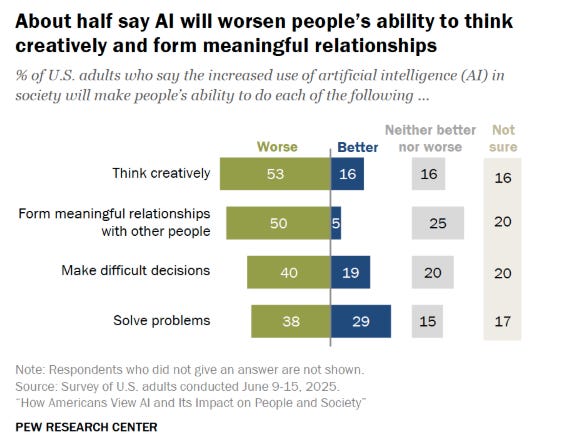
Americans are far more pessimistic than optimistic about the effect AI will have on human creativity and connection. About half (53%) say AI will worsen people’s ability to think creatively, while 16% say it will improve this. And 50% say it will worsen people’s ability to form meaningful relationships with others, while only 5% say it will make this better.
People: Cozy lit. Exhausting a place (and the Overloaded Man (PDF)). You’re a frog. Cognitive ease at a cost. Aesthetics. Bubble girls. Sl-tcon ??? Housing’s to get together.
Oregon absenteism.Futures: JB’s take. 2026 trends folder (gdrive). Crisis and polarization.
Business: America polarization as side hustle.
AI: Chatbot writing style. MP use more AI than ever in their speeches. Slop recipes. Using ChatGPT smartly.

Frogs in the Sunshine
As the sun dipped low, casting orange shadows across the Oregon landscape, Jamie sat on the weathered park bench with a view over the high school across the street. She was supposed to be keeping an eye on her younger brother, who had decided to “attend a virtual class” from the comfort of a nearby pizza place, which was rather more “class” than “virtual.” The truth is, he’d been absent so many days—thirty percent, by recent estimates—that they’d practically put a “For Sale” sign on his educational progress. It all felt a bit like watching someone try to use a slinky as a straightedge; it wasn’t going to help, but it was entertaining nonetheless.*
While Jamie pondered how to improve his attendance rates, she scrolled through social media. A particularly juicy thread about something called “frogposting” caught her eye. “Ah, the nostalgia for simpler times,” she mused, sighing over the colorful images of amphibians bathing in the sun, a desperate yearning for a life void of student loans and career expectations. Perhaps if her brother spent less time pondering his absence from class and more time imagining himself as a frog, the weight of the world might lift off his slim shoulders.
But then her eyes drifted over to the “news” floods featuring ominous posts about bots pretending to be people, sock puppets masquerading as genuine accounts. “Isn’t that just the pinnacle of irony?” she chuckled to herself. Here were individuals craving authenticity while navigating a landscape littered with disinformation and inauthenticity that felt like a bad episode of *Black Mirror*. It made reaching out for genuine connections a task akin to finding a needle in a hillside of hay bales soberingly operated by faceless algorithms.
With a roll of her eyes, Jamie glanced up from her screen, taking note of discarded pizza boxes littering the scene. The very things that filled her brother’s belly spurred thoughts of her own unfulfilled ambitions. Maybe they needed a goal reset of sorts. The idea of adjusting one’s aspirations downward, as one author put it, began to dance around her mind like the frogs in those online posts. “Why not focus on celebrating small victories?” she proposed aloud to herself. “Just passing math should be a cause for a family pizza party.” Up until now, it felt like they were competing in some exhaustive marathon filled with unachievable goals.
After wrestling with thoughts of academic performance and the nature of authenticity, Jamie felt an itch for some fresh air. Tomorrow, she would drench her list of ambitions with some good old-fashioned self-care; perhaps a wander downtown to where life still flickered behind the veil of her smartphone. Her friend, an enlightened “Bubble Girl,” always said embracing a low-tox lifestyle can provide clarity amid the chaos pandemic-induced habits had brought into her life. “I could use a good detox from Wi-Fi equally as toxic,” she quipped, and before she knew it, she was making a mental note to reconnect with her own humanity.
As she pushed up from the bench, a burst of paranoia gripped her for a second: What if her own aspirations were indeed polluted by an algorithm promising encouragement? She grinned, shaking her head, knowing that the only way out was to embrace life in all its chaotic messiness—and the absurdity of “Slutcon” workshops on learning intimacy could begin to sink in. Intimacy, connection, the subtle art of human touch in a world spiraling toward a lonely screen—it was all intertwined like an outrageous yarn spun from reality and whims.
She made her way toward the school’s entrance, heart set on guidance over instruction, love over perfection, realizing that the best way to combat absenteeism might just involve showing up, not just physically but as a beacon of understanding. After all, even if the world was teetering on the brink of AI-controlled absurdity, at least the frogs were always there—waiting patiently for their moment in the sun.