

“In general, tech industry sources expressed more extreme concern about the labor market impacts of AI in private conversation — but suddenly became optimists once I turned on the mic.” — Jasmine Sun, The New York Times
“René Walter builds a conceptual framework for understanding LLMs through the history of archival thought. He closes the essay by framing LLMs as a new form of orality rather than literacy. Where traditional archives ground knowledge in traceable sources and authorial intent, these interpolatable archives generate responses the way pre-Homeric bards constructed epic verse: on demand, from mnemonic formulas, without a fixed text behind them.” through Patrick.
“Le produit dérivé de la dénutrition conversationnelle qui gagne du terrain, c’est l’absence cruelle de vérité dans nos relations.” — Umanz, Belief markets, doomprompting et algorithmisation des gens
People: La disparition du “moyen” — from the spinning-top society to the hourglass society (FR). Still finding your footing — what happens after the job search ends.
AI: Frontier models tested on role-playing philosophers. Chinese courts rule: replacing someone with AI is not a lawful reason to fire them, one of the first such decisions worldwide.
Quantity of AItext produced on the web.
Claude knows who you are with because .. writing style (or because of what you consume?).
Doing books as AI companions =)Business: Asymmetrical interconnectedness. AI Act could force universities to change everything about how they use AI — academics using ChatGPT to grade may violate the law. Ticketing driverless cars. Iran vs the US engine.
Futures: Looking back — a reflection on the futures field. Walter Benjamin’s framework extended from art to knowledge in the age of AI reproduction. Rewiring care systems. Antidystopias.
MIT Future fest.Security: GPT-5.4-Cyber announced — OpenAI releasing a comparably capable model less restrictively than Mythos. Palo Alto portal vulnerability.
Art: Réflexions empruntées — en espérant semer quelques graines (FR). Joachim Trier, skateboarder. A caught moment — “This is not an image of the product, but its process.” Don’t call it a book tour.
Random: How much stuff do you own? Follow-up roundup. The Disclosure Edition — on UAPs, the new Spielberg, and government transparency. Sophie la girafe n’est pas le symbole français qu’on croyait (FR).
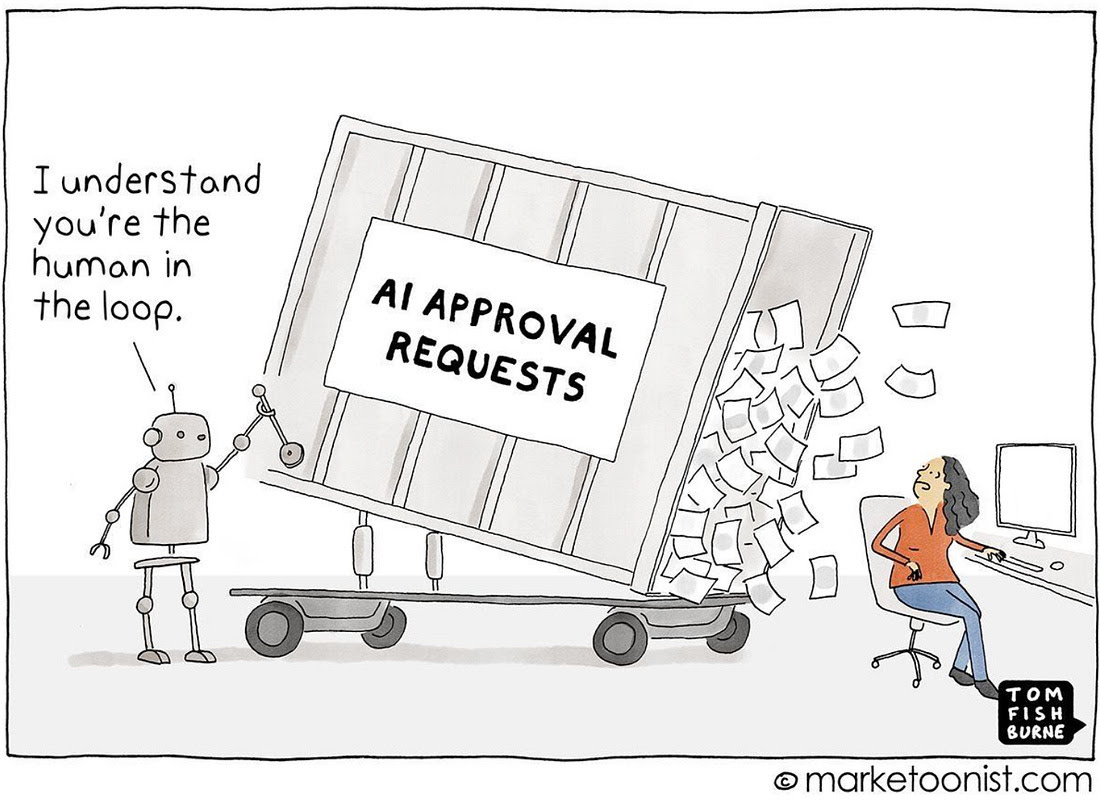
The Off-Record Pessimists
The journalist turned off the mic, and the optimism evaporated like dew on a semiconductor.^1
Hank read the quote twice. He had been following Jasmine Sun’s reporting for months — her ability to get Silicon Valley’s builders to say what they actually believed, which was different from what they said on stage, which was different again from what they built. The pattern was consistent: in private, engineers at the frontier labs expressed extreme concern about labour market displacement. In public, they pivoted to the language of opportunity, upskilling, augmentation. The gap between the two positions was not a contradiction. It was a strategy.
“The beliefs become behaviours,” he said to Avery over lunch. “They think junior hiring is over. So they stop hiring juniors. And then junior hiring is over.”
Avery, who had been reading about GPU rental prices — B200s up 114% in six weeks, Microsoft requiring Blackwell customers to lock in a thousand chips for a year — found this observation distressing but not surprising. “It’s the announcement effect again,” she said. “Last month it was fitness streaks. This month it’s the labour market. The declaration creates the reality.”
“Except in fitness, the declaration is public. Here, the declaration is private. They’re pessimists off the record and optimists on it. The displacement happens in the gap.”^2
Their colleague Derek had spent the morning reading about the EU AI Act trilogue collapse. The negotiations had fallen apart over machinery and medical devices — not the existential questions about frontier models that dominated the headlines, but the mundane regulatory details that actually determined whether the law would work. Meanwhile, the European Parliament had invited Anthropic to a hearing on Mythos. The model could autonomously complete all thirty-two steps of a corporate network attack simulation. The AI Office, tasked with overseeing such systems, had forty staff and no Advisory Forum seven months after the call for interest had closed.
“Forty staff,” Derek said. “For a technology that generates five and a half trillion tokens per day at a single Chinese company.”
Matt, who managed the firm’s wellness programme, had been reading about something entirely different. A philosopher had tested seven frontier models on their ability to simulate expert philosophical judgment. The models performed adequately on questions where philosophers already agreed. But on questions where they disagreed — the interesting ones, the ones that mattered — real philosophers showed two to four times more variance than the AI.
“The models are too agreeable,” Matt said. “They converge. Human thinkers diverge.”
“That’s the whole problem,” Hank said quietly. “We’re building systems that agree with themselves. And then asking them to replace people who don’t.”^3
That evening, he read about a Chinese court ruling that replacing someone with AI was not, by itself, a lawful reason for dismissal. It was one of the first such decisions anywhere in the world. The ruling didn’t say AI couldn’t do the work. It said that doing the work was not the only thing that mattered. There were other considerations — dignity, continuity, the relationship between a person and their role — that the technology could not account for and the law was obliged to protect.
Hank closed his laptop. Outside, the sun was setting over Exeter in the way it always did, which is to say, without requiring five and a half trillion tokens to describe it. He poured a glass of water and sat in the quiet of a house that had no inference load, no GPU rental premium, and no Advisory Forum.
“The gap,” he said to nobody, “is where we live.”
^1 This is the defining metaphor of the current AI moment: the mic as moral toggle. On-record, everything is augmentation. Off-record, everything is displacement. The truth is in neither position but in the distance between them.
^2 The fitness analogy proved strangely durable. Announcing your marathon training reduces your chance of finishing it. Announcing that AI will replace juniors reduces the number of juniors hired. In both cases, the declaration substitutes for the work.
^3 The variance finding is, philosophically, devastating. If the value of human thought lies in its disagreement — in the range of positions a mind can hold — then a system that narrows that range is not augmenting thought. It is replacing it with consensus. And consensus, as any philosopher will tell you, is where thought goes to die.
^4 The Chinese court ruling may prove to be one of the most consequential legal decisions of the decade, not because it stops AI adoption, but because it establishes that the relationship between a worker and their work has value independent of the work’s output. This is either obvious or revolutionary, depending on which century’s economics you subscribe to.