

“It’s difficult to figure out how much anything AI-related costs.”
— senior Amazon employee, via Exponential View“Abductive reasoning is what gets us from epicycles to elliptical orbits. It’s where new ideas come from.”
— Gordon Brander, Squishy Computer
People: South Korea’s dopamine sites — apps and platforms that simulate shopping without purchase. AI spending stratification: Ramp reports that in July the top 1% of businesses spent a median $7,400 per employee on AI, the top 10% spent $650, and the median firm spent $11.95.
AI strat: The $6 agent — Amazon spent $1.8 million on a single Claude project over five months; one team’s autonomous agent peaked at $500 per day before a model-routing audit brought it to $6. Botsitting: AI agents require roughly 6.4 hours of human oversight per week. Where LLMs fall short. Opus 5 and revenue concentration. AI watermarking.
Tech: Google’s departures as capital signal. Price war accelerates. Invisible drones.
Security: Keyv supply chain attack. Coldcard hack.
Society: One Night Only.
Random: Five silences — a language essay notes that spoken language contains at least five distinct forms of silence — the pregnant pause, the companionable silence, the awkward silence, the menacing silence, the reverent silence.
Foresight: Organizational tools for personal disruption.
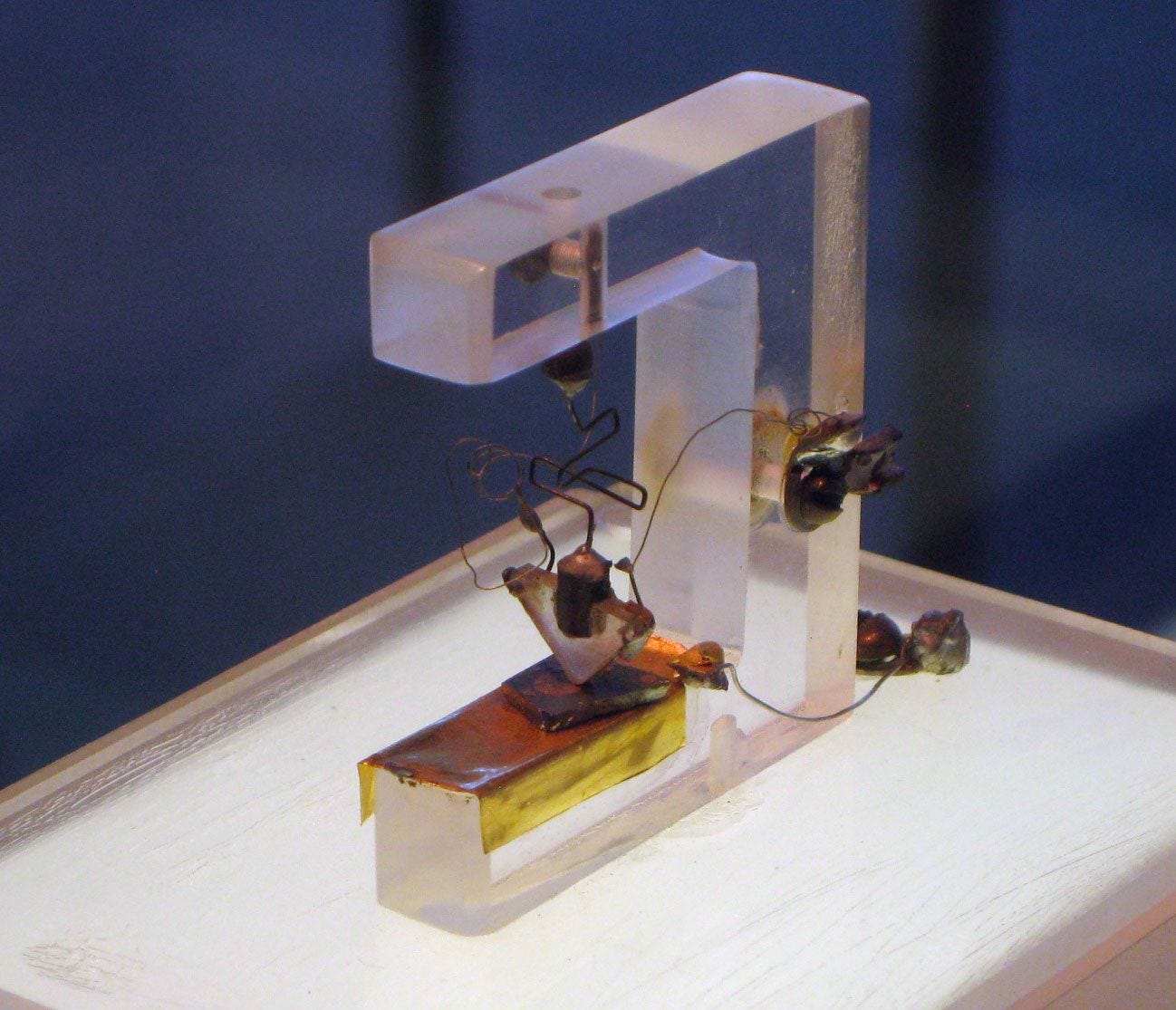
Bell Labs produced: the transistor, the laser, the solar cell, Unix, the C programming language, information theory, cellular networks, the detection of cosmic microwave background radiation. None of these had a clear return on investment at the time of the work. The researchers were not asked to justify the compute. The era in which that was true lasted approximately forty years.
The Hurdle Rate
The meeting had been on the calendar for three weeks, which was how Nadia knew it was serious. Informal concerns appeared without warning. Structural ones had lead time.
Priya from Finance was there, which settled the matter. Nadia had brought her most recent results — not polished into a deck, because she had found that decks created the impression of conclusions where there were only questions, and the work she was doing was questions, deliberately, all the way down.
“The compute allocation question,” Marcus said. He ran infrastructure. He had the numbers. “At current utilization, the models serving production queries are generating approximately eleven times the revenue per GPU-hour compared to research workloads.”
Nadia said she understood the number.
“The ask isn’t to stop the work,” he said. “It’s to think about what the work needs, versus what it has.”
She thought about explaining what she was doing. She had been trying for six months to identify the conditions under which a language model would generate a genuinely novel hypothesis — not a recombination, not an extrapolation, but an abductive leap: the mechanism that would explain a finding the model had not been trained to explain. She had a method. She had intermediate results. She did not have a timeline, because the nature of the work was that the interesting finding would arrive when it arrived, which was not schedulable.
“What’s the use case,” Priya said. Not a question.
Nadia thought about this. The use case was: if she found what she was looking for, AI systems could eventually do science in the way that scientists do science — not just processing what was already known, but generating the hypothesis that reordered what was known into something new. The use case was: Kepler. The use case was: the discovery that the orbits were ellipses, not circles, which required someone to hold an anomaly in mind long enough to find the shape that explained it.
She said: “It’s a foundational capability question.”
Marcus nodded as if this confirmed something. “The production systems are generating value now. The research has a longer horizon.”
“Yes,” she said.
“And the question is whether this is the right place for a longer horizon.”
She had known this meeting was coming. She had been watching the allocation numbers shift for four months. She had told herself there would be a conversation, and then there would be a process, and that she would find a way through it. She had been wrong about the process. The conversation and the conclusion were the same meeting.1
She left three months later. She took one postdoc and a modest compute budget from a foundation she had spent two years cultivating. The work was slower. The results arrived more irregularly. She had no production deadline.
In the following year, she published two papers. Neither received much attention at the time. Both were cited heavily within three years, by researchers at the same lab she had left, who were trying to solve a problem that had arrived from a direction no one had been looking.2
1 The hurdle rate — the minimum return required to justify an investment — is a useful tool for allocating resources between competing projects with similar time horizons. It is a less useful tool for distinguishing between work that generates value in three years and work that generates value in thirty. Organizations that apply the same hurdle rate to both will consistently defund the second category, which is not an error in the calculation but a limitation of the instrument. Bell Labs worked because AT&T’s monopoly revenues were large enough and stable enough that the opportunity cost of funding open-ended research was low. When the monopoly ended, the instrument changed and the research followed.
2 The abductive leap — the moment when an anomaly resolves into a mechanism — is not evenly distributed across time or institution. Kepler had Tycho Brahe’s data and eight years to stare at the problem of Mars. Newton had a plague year and an empty Cambridge. Fleming had a contaminated petri dish he had not yet thrown away. The conditions for the eureka are not the conditions for the quarterly return, and organizations that mistake the second set of conditions for the first tend to discover this difference from the outside of the discovery.