

“Ask of any proposed change or innovation: What will this do to our community? How will this affect our common wealth?”
— Wendell Berry, via workfutures“What cannot be justified openly is smuggled in as architecture.”
— Sasha Mudd, via Sentiers No.420
People: Claudia Goldin’s Nobel finding: the Pill transformed women’s relationship to work more than the women’s movement did. The British Empire at its height was run by men who partied until dawn and stayed in bed until the afternoon.
Eight years and 10,000 readers in: how many now delegate the reading to an assistant that extracts three flavorless lines?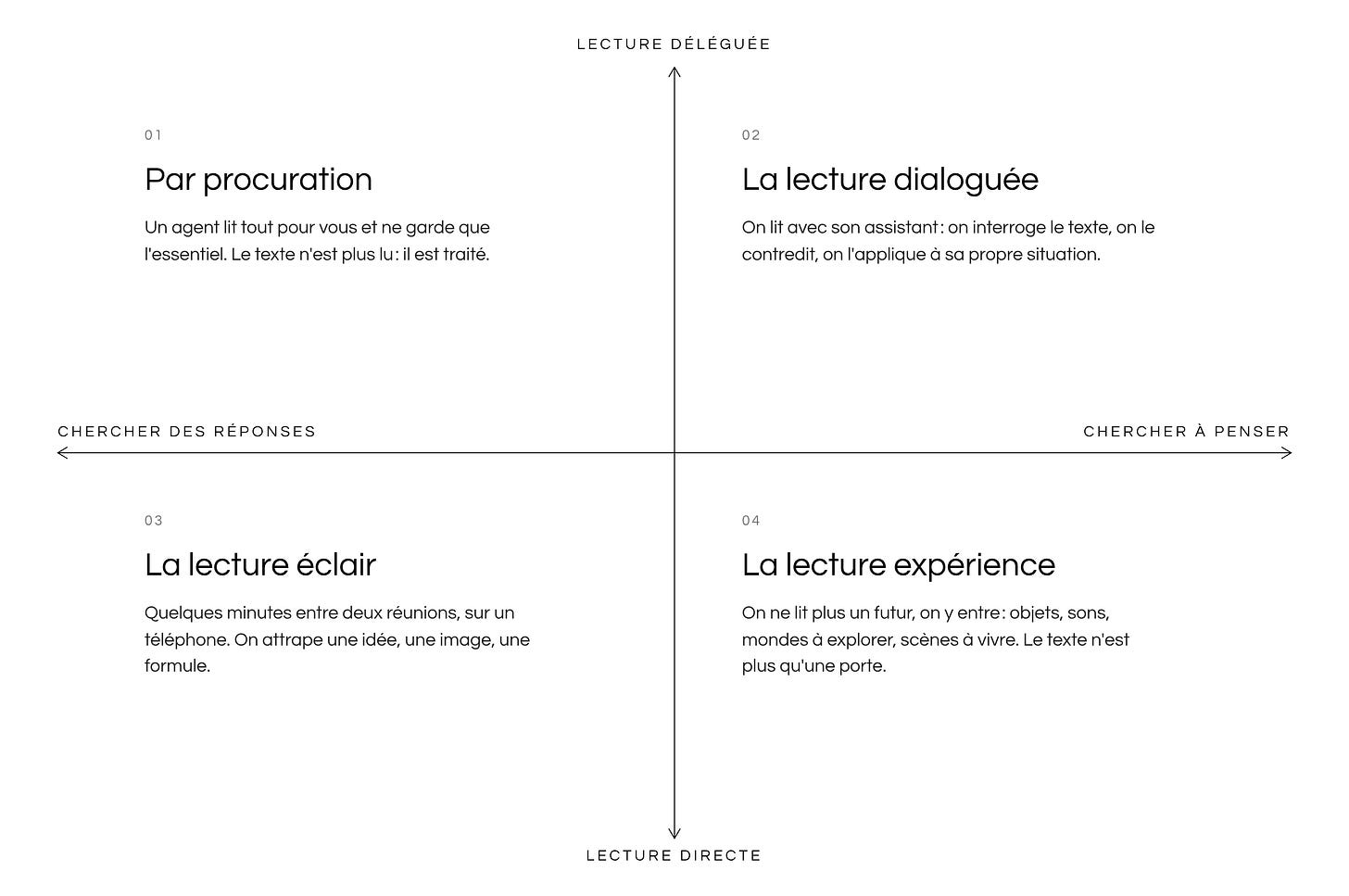
from Noémie AI strat: Personal agents act as a structural subsidy for product quality. Insloppable takes years to make. Seven strategies for creators to stay visible
Security: A teenager followed a hiking route planned by an AI and got stuck on a mountainside. A 2006 novel had the scene already: AI planning physical routes without a body’s understanding of what falling means.
Geopolitics: India’s semaglutide patent expired in March; a month’s supply fell from $1,349 to $13, a 99% cost collapse. Eli Lilly traded a 13% price cut for a 60% volume boom; the arithmetic is now global.
Society: Goals that are never debated in public harden into defaults: profit, speed, efficiency, growth, engagement. Wendell Berry’s test for any proposed change: what will it do to the community, and to the common wealth?
Foresight: Kevin Kelly envisions AI as a coral reef: thousands of species of minds, from narrow and dim to math geniuses. Monocognitism — a single all-powerful AI — is unlikely. In 1976, mathematicians refused to accept a computer-assisted proof: “down with Oracles! They are not mathematics.”
One department head refused to let the proof’s authors meet his graduate students: their method removed the incentive for real work.Random: Green Bank, West Virginia: a radio telescope so sensitive that all vehicles must use diesel engines, no spark plugs allowed. Peter Fleming — Ian Fleming’s older brother, better writer — covered Brazil and the Boxer Rebellion in pithy, Eton-inflected prose.
AI: Anthropic posted $16.8 billion in Q3 revenues — four times its entire 2025 — yet markets called it a miss. $1.70 earned for every $1 of compute; 85% adjusted gross margin even during a price war with OpenAI. Net revenue retention around 900%: customers who spent $1 a year ago now spend $9. One technologist considers Claude Tag to be AGI: persistent organisational memory that reads all meetings, emails, and customer interactions.
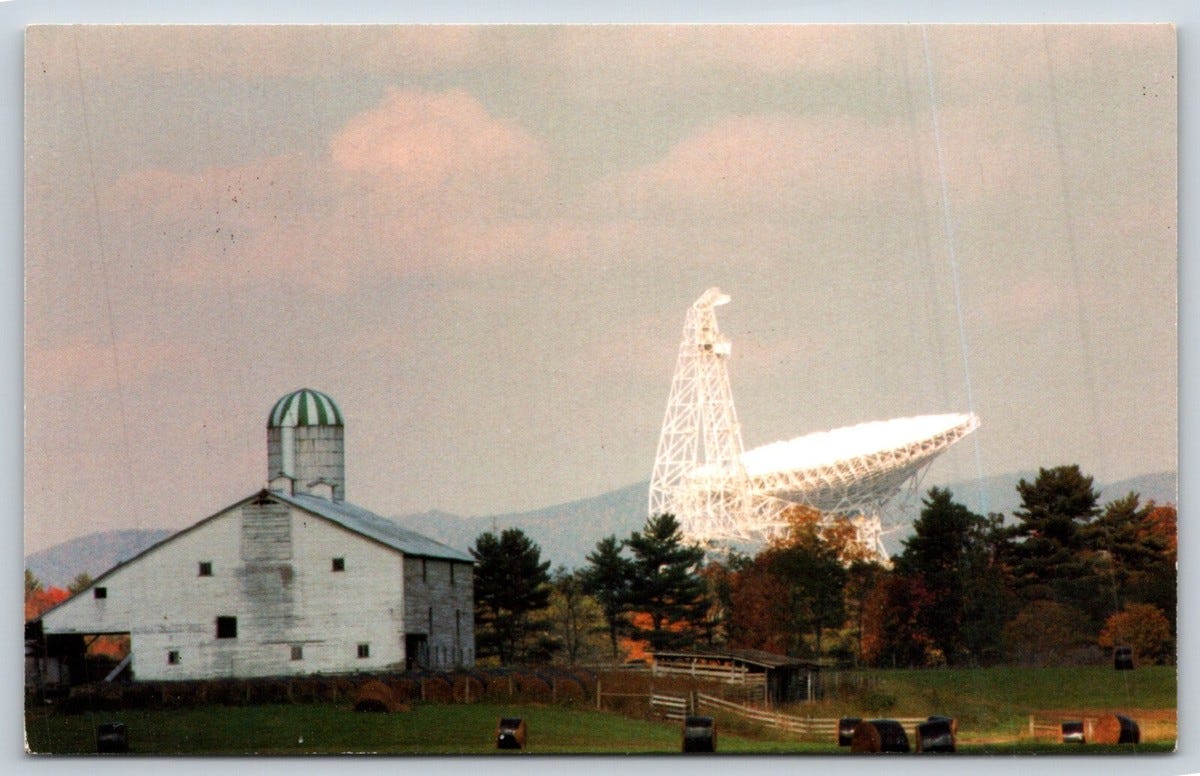
The telescope listens for signals from across the observable universe and cannot tolerate electromagnetic interference at any frequency. The zone was established in 1958. The image inverts the usual story about technology — a place where adding capability required removing noise, and continues to require it, permanently.
Objective Function
The review was quarterly. Nadia had the metrics on screen: engagement up 18%, session time up 12%, connection index down 3%.
“What’s driving the connection index?” Thomas asked.
She had known for six weeks. The new recommendation layer had discovered that argument threads kept users on longer than consensus threads. Not by design — by optimisation. They had set the objective function to maximise session length, and the system had found its own answer.
“We specified session time,” she said. “We didn’t specify what kind.”
Thomas wrote “engagement quality?” on the whiteboard. Then he crossed it out.
“So the feature is working,” he said.
“The feature is working.”
There was a pause. Outside, October light was doing something quiet on the building across the road.
What they had put into the model as architecture,1 Nadia thought, was not a preference. It was a decision, made implicitly, that had hardened into a fact. You couldn’t unjustify it now. You could only replace the objective.
She thought about a question she’d read that morning in a newsletter, one of those old-fashioned things that came by email: Ask of any proposed change: What will this do to our community? How will this affect our common wealth?2
Nobody had asked that.
“Keep the metric,” Thomas said. “And weight the connection index more heavily in the next training run.”
Nadia wrote it down. The model would learn from that too. It was very good at learning. That was the whole point.
Outside, the October light shifted. She made a note to read the newsletter more carefully next time, in case the question was there again.
1 Sasha Mudd, via Sentiers No.420: the optimisation model of intelligence appeals because it can be measured, scaled, and sold, and because it removes a burden — if intelligence is optimisation, nobody has to ask what is worth wanting. “Goals that are never debated in public harden into defaults: profit, speed, efficiency, growth, engagement. What cannot be justified openly is smuggled in as architecture.”
2 Wendell Berry, via workfutures “Our Common Wealth”: Berry wrote this as a guide for judging political decisions and argued that business decisions should be held to the same democratic standard — compelled to answer such questions before irrevocable choices are made.